
A Scalable Navigation Model Designed for an Agentic Navigation System
Qwen Team
Welcome to the official repository of Qwen-RobotNav. Here, you can find official information about Qwen-RobotNav and post your questions (Issues).
Note: There is currently no plan to release the model weights for Qwen-RobotManip or Qwen-RobotNav. We will continue adding report resources that can be publicly released to this repository.
clipboard.mp4
If the video does not render in your browser, open the direct demo preview link. For the full-length high-resolution source, open big_agent.mp4.
This blog demo highlights the key design features of Qwen-RobotNav: unified multi-domain navigation, controllable observation context, agentic tool-call style execution, and zero-shot real-world deployment.
clipboard.mp4
If the feature video does not render in your browser, open the direct feature preview link. For the full-length high-resolution source, open Nav_blog_demo.mov.

Qwen-RobotNav is a scalable navigation model built on Qwen3-VL. It unifies instruction following, point-goal and object-goal navigation, target tracking, autonomous driving, and embodied question answering under a shared waypoint-prediction interface.
The key idea is to treat navigation as context modeling. Different navigation tasks share a perception-planning backbone, but they require different strategies for consuming visual history: long-horizon instruction following needs memory, target tracking needs recent high-resolution frames, object search shifts between exploration and local approach, and driving depends on multi-view short-term motion context.
Qwen-RobotNav exposes this difference as a configurable observation protocol. An upper-level planner can call the same model with different task modes and context parameters, making Qwen-RobotNav a natural navigation primitive for agentic systems.
-
🧭 Unified Multi-Domain Navigation. One model covers VLN, PointNav/ObjectNav, target tracking, autonomous driving, and EQA.
-
⚙️ Controllable Observation Protocol. Token budget, temporal decay, per-camera weights, and frame sampling mode are inference-time controls.
-
🧠 Agentic Navigation Interface. The model can be called as a reconfigurable waypoint executor inside a two-tier planner with memory.
-
📈 Scalable Training. Qwen-RobotNav is trained on 15.6M samples with trajectory supervision and vision-language co-training, showing favorable scaling from 2B to 8B.
-
🌍 In-the-Wild Generalization. The model demonstrates zero-shot transfer to real-world robots and unseen environments.
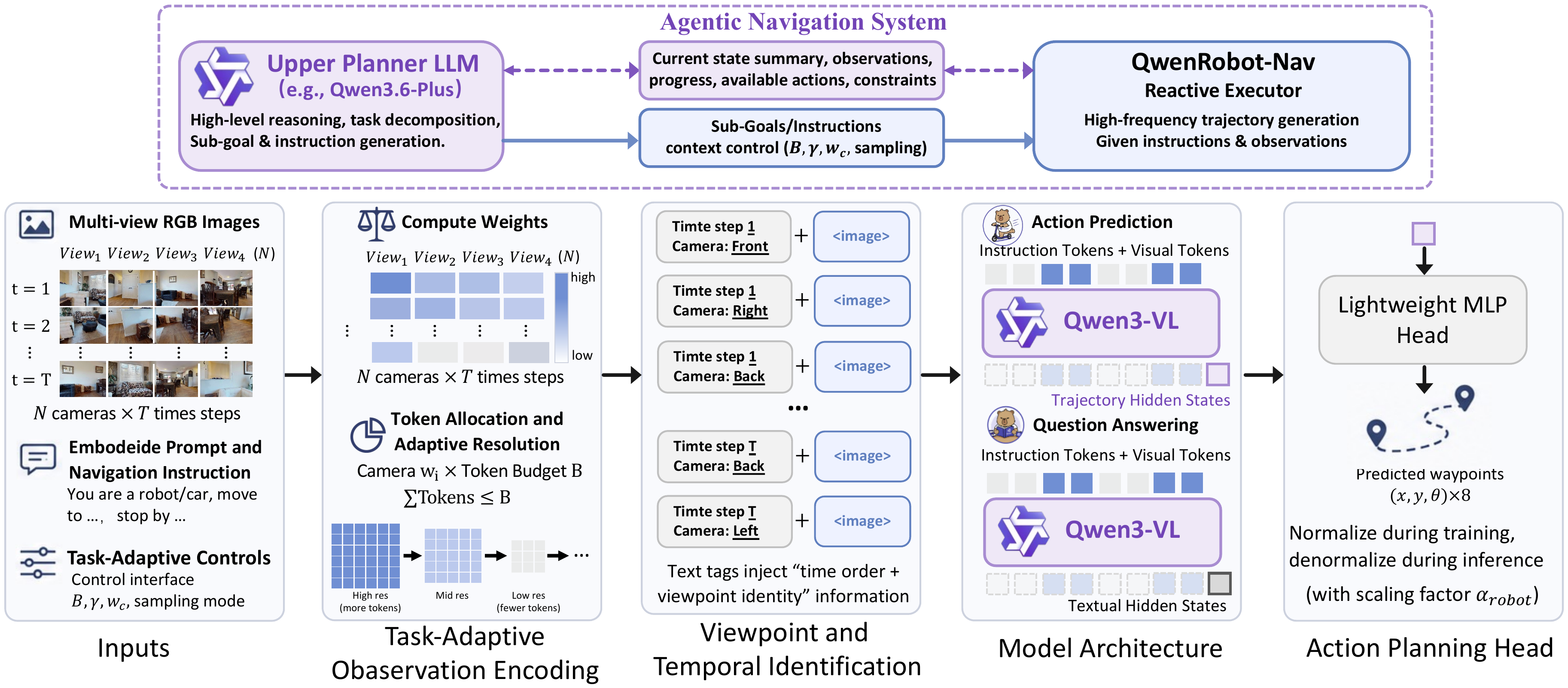
Qwen-RobotNav inherits the Qwen3-VL backbone and adds a lightweight 4-layer MLP action head. It outputs 8 waypoints, each parameterized as (x, y, theta), so diverse navigation tasks can be expressed as trajectory prediction under different prompts and observation configurations.
The core interface is a task-adaptive observation protocol with four main control axes:
- Visual token budget: total visual tokens shared across cameras and timesteps.
- Temporal decay: how strongly recent frames are favored over older observations.
- Camera weights: per-camera importance, such as emphasizing the forward view.
- Frame sampling mode: random sampling for broad history coverage or latest-frame sampling for recency.
During training, these parameters are randomized per sample. This lets Qwen-RobotNav accept new inference-time configurations without modifying the Qwen3-VL backbone or retraining a task-specific model.
Temporal order and camera identity are represented with natural-language tags interleaved with visual tokens, such as Time step 0 and Front View <image>. This reuses Qwen3-VL's language space rather than adding custom time or viewpoint embeddings.
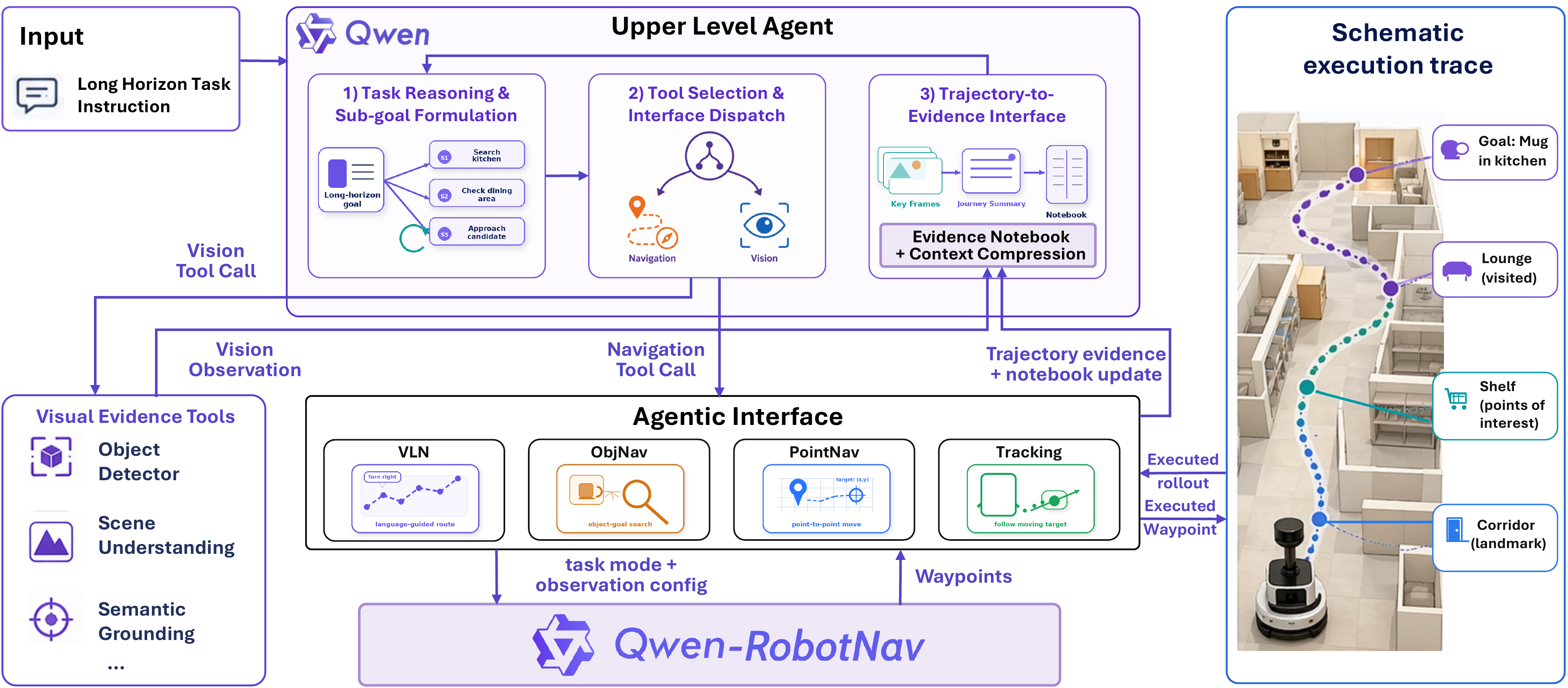
In the agentic system, an upper-level planner decomposes long-horizon goals into sub-goals, chooses the task mode, and sets the observation configuration for each call. RobotNav executes each segment as a reactive waypoint predictor, while compact trajectory summaries and persistent evidence memory keep the planner grounded over long episodes.
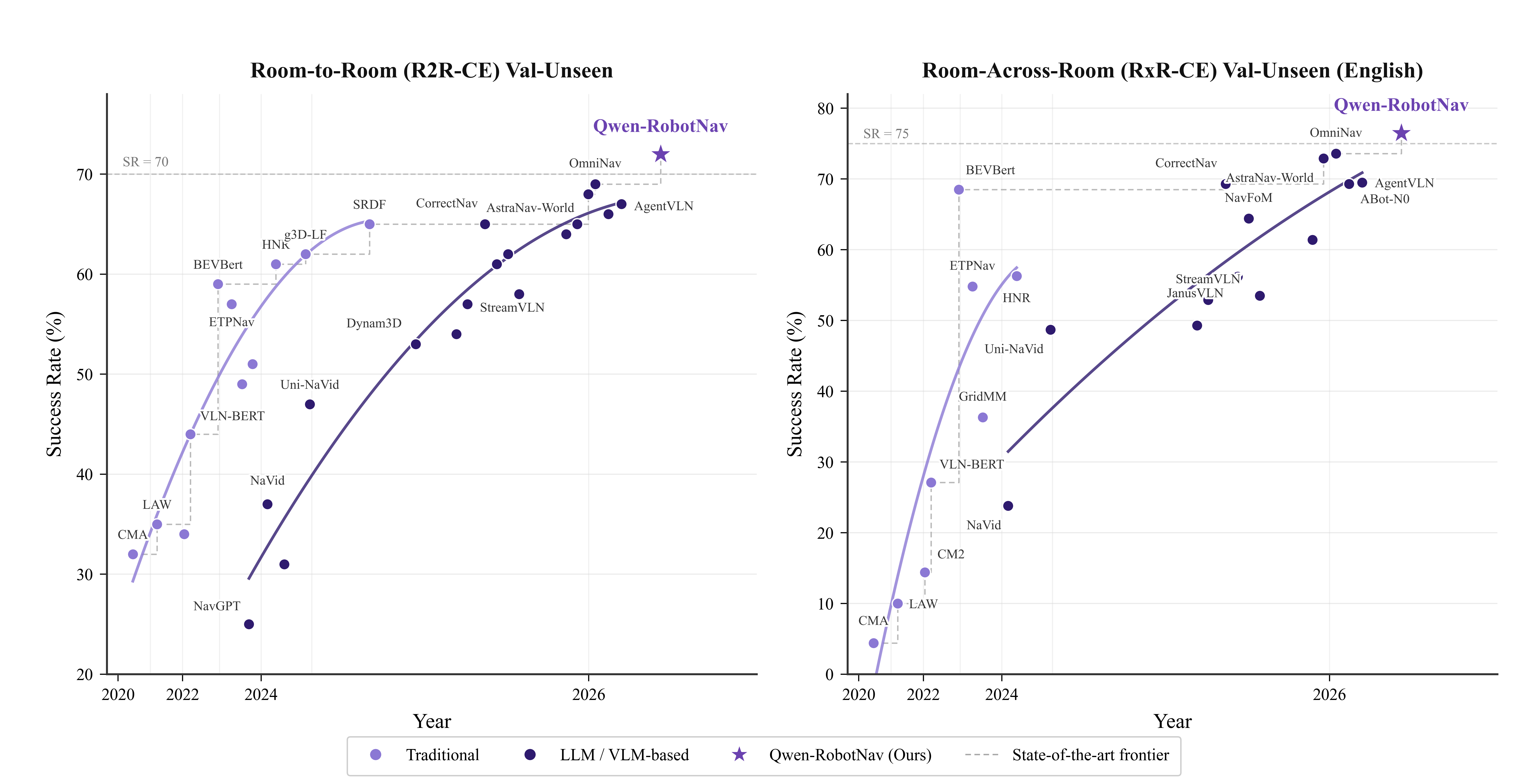
Qwen-RobotNav-8B achieves strong results on R2R and the longer-horizon RxR validation-unseen splits.
| Model | R2R SR (%) | R2R SPL (%) | RxR SR (%) | RxR SPL (%) |
|---|---|---|---|---|
| NaVILA | 54.0 | 49.0 | 49.3 | 44.0 |
| NavFoM | 61.7 | 55.3 | 64.4 | 56.2 |
| ABot-N0 | 66.4 | 63.9 | 69.3 | 60.0 |
| OmniNav | 69.5 | 66.1 | 73.6 | 62.0 |
| Qwen-RobotNav-4B | 69.5 | 63.6 | 75.2 | 65.0 |
| Qwen-RobotNav-8B | 72.1 | 66.6 | 76.5 | 65.7 |
| Benchmark | Model | Main Metric | Additional Metric |
|---|---|---|---|
| HM3Dv2 ObjectNav | Qwen-RobotNav-4B | 75.6 SR | 30.6 SPL |
| EVT-Bench Tracking | Qwen-RobotNav-4B | 90.0 TR | 77.4 SR |
With the agentic navigation system, Qwen-RobotNav improves both exploration quality and answer accuracy.
| Method | HM-EQA Acc. (%) | MT-EQA Acc. (%) | EXPRESS LLM Score |
|---|---|---|---|
| Explore-EQA | 58.4 | 36.2 | - |
| Memory-EQA | 61.4 | 43.1 | - |
| FAST-EQA | 69.2 | 50.5 | 68.7 |
| Qwen3.5-Plus + QwenNav-8B | 74.1 | 52.1 | 77.66 |
| Qwen3.6-Plus + QwenNav-8B | 76.7 | 54.4 | 79.27 |
| Model | NC | DAC | TTC | Comfort | EP | PDMS |
|---|---|---|---|---|---|---|
| NavFoM | 97.7 | 93.5 | 92.3 | 100 | 79.6 | 84.3 |
| AutoVLA | 98.4 | 95.6 | 98.0 | 99.9 | 81.9 | 89.1 |
| ReCogDrive | 97.9 | 97.3 | 94.9 | 100 | 87.3 | 90.8 |
| ReflectDrive | 97.7 | 99.3 | 93.5 | 100 | 86.9 | 91.1 |
| Qwen-RobotNav-4B | 99.8 | 97.5 | 98.5 | 99.9 | 84.4 | 91.4 |
The task-adaptive observation interface is evaluated by changing inference-time context controls on 500 VLN-CE R2R Val-Unseen episodes with Qwen-RobotNav-4B. These ablations show that the interface is not just a formatting choice: changing the call-time configuration changes how the same model trades off long-term memory, current-scene fidelity, and path execution.
| Interface Control | Sweep Setting | Key Result | Takeaway |
|---|---|---|---|
Visual token budget B |
B=2048 to 4608, fixed gamma=2.0 |
SR improves from 70.8% to 74.6%; OSR rises from 78.9% and peaks at 82.7% when B=3584 |
More visual context helps goal reaching, but very large context shows diminishing returns. |
Temporal decay gamma |
gamma=0.5 to 3.5, fixed B=3072 |
OSR improves from 78.8% to 82.6%; SR peaks at 72.5% when gamma=3.0 |
Stronger recency bias improves current-scene resolution, but can trade off early-history context. |

This supports the core design choice of exposing context as a controllable interface. A long-horizon route-following call can allocate more tokens to historical frames, while tracking or local approach can emphasize recent observations without retraining or changing the architecture.
Qwen-RobotNav is deployed zero-shot on a Unitree Go2 quadruped robot with on-device inference via NVIDIA Jetson Thor, achieving 196 ms latency (5.1 Hz) in the blog deployment. The only visual input is the Go2's built-in low-resolution camera, and the real-world experiments are conducted in previously unseen environments without environment-specific fine-tuning.
clipboard.mp4
If the deployment video does not render in your browser, open the direct deployment preview link. For the full-length high-resolution source, open agent_demo.mp4.
| Scenario | Setup | Result |
|---|---|---|
| Fine-grained indoor control | Apartment deployment with the Go2 built-in camera and step-by-step natural-language commands | Traverses bedroom, living room, and bathroom while responding to fine-grained spatial directives. |
| 21.78 m back-and-forth VLN | Unseen exhibition hall, from living-room area to hospital room and then reverse route | Maintains landmark grounding over a long route and executes bidirectional language-conditioned control. |
| Agentic navigation | Open-ended Cotti Coffee umbrella query with planner calls to Qwen-RobotNav | Decomposes the task into sub-goals, navigates with corridor landmarks, inspects the target scene, and returns an evidence-grounded answer. |
-
Fine-grained indoor control. In an apartment setting, the robot follows step-by-step natural-language instructions across the bedroom, living room, and bathroom, while responding to spatial directives such as stopping at a specified side of furniture or taking a detour before exiting a room.
-
Long-horizon instruction following. In an unseen exhibition hall, the robot navigates 21.78 m from a living-room area to a hospital room using pure language instructions, grounding the route in landmarks such as furniture, doorways, and signage. It then receives a reverse command and retraces the route back toward the starting pose, testing bidirectional spatial grounding rather than one-way route execution.
-
Agentic navigation. For the open-ended request "check whether a green umbrella was left at Cotti Coffee," the upper-level agent decomposes the task into sub-goals, uses corridor landmarks for localization, asks Qwen-RobotNav to execute grounded navigation segments, inspects the target scene, and returns an evidence-grounded answer without human intervention.
Additional full-length deployment sources: apartment case 1, apartment case 2, apartment case 3, apartment case 4, living room to hospital room, and hospital room to living room.
If you find our work helpful, feel free to give us a cite.
@misc{qwenrobotnav2026,
      title={Qwen-RobotNav Technical Report: A Scalable Navigation Model Designed for an Agentic Navigation System},
      author={Qwen Team},
      year={2026},
      eprint={2606.18112},
      archivePrefix={arXiv},
      primaryClass={cs.RO},
      url={https://arxiv.org/abs/2606.18112},
}